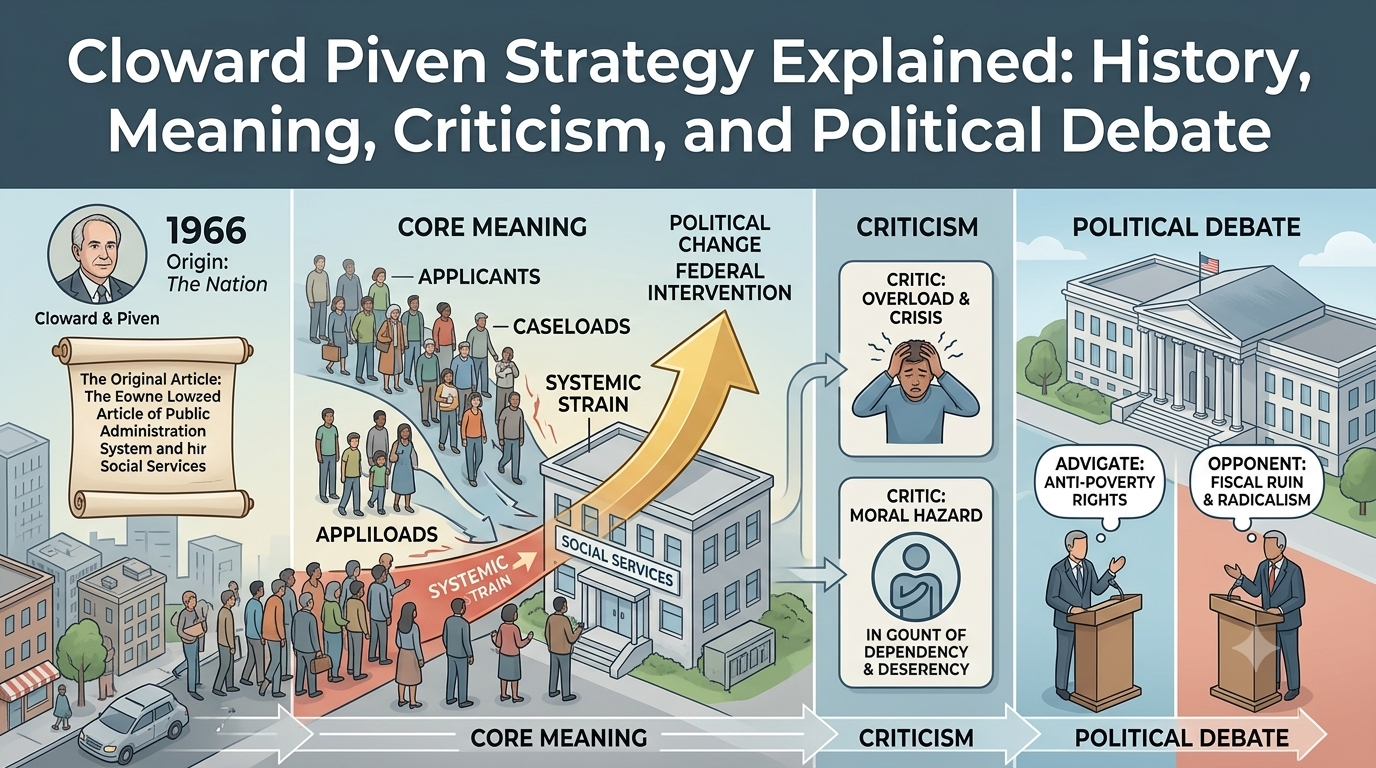
Cloward Piven Strategy What Does it Mean? 2 decades, for instance, has the term Cloward-Piven strategy been causing heated debates. In particular circumstances, some sources will claim it to be a conspiratorial tactic meant to purposefully induce crises inside the government, whereas others might think about it to be the strategy for social activism meant to shed light on the faults of social welfare applications, encouraging politicians to execute wider reforms.
3 years prior to it has actually ended up being a well-liked name in American politics, the concept initially came in 1966 if the researchers Cloward and Frances Fox Piven released a magazine labeled “The Weight of the Poor: A Plan to End Poverty,” in which the two authors discussed welfare benefits, social welfare issues, and the role of government policies in addressing poverty. and not about some version that is basic that will certainly end up being discussed in politics after several decades.
To get a clearer picture about Cloward-Piven tactic, you might like to go back to a starting point, realize just what the 2 analysts intended initially, how it was looked at by movie critics, and why does the term proceed being invoked.
Why the Cloward Piven Strategy Matters
Political strategies often become controversial because their meaning changes over time. A concept developed in one historical moment may later be used as a symbol in broader ideological debates.
The Cloward Piven strategy matters because it raises important questions about:
- How social movements influence government policy
- Whether political pressure can produce major reforms
- How welfare systems respond when demand increases
- The relationship between activism and institutional change
The debate surrounding this strategy also demonstrates how political ideas can be interpreted differently by supporters, opponents, and outside observers.
Understanding the Cloward Piven Strategy
Cloward Piven Strategy here’s what it was: Richard Cloward and Frances Fox Piven (American sociologists who work with American politics concerning poverty, social welfare policies, and organization) outlined their proposed approach in a 1966 essay.
Poor and eligible for assistance were, “ denied any benefits in a complex system of procedures, of formal and informal policy,” that included a general lack of awareness to “ anti-poor biases” and the solution, “ the mobilization of the poor toward political empowerment” to claim their eligibility. “ “This would expose latent deficiencies within local social welfare systems and create a positive incentive to strengthen efforts to address existing social needs.” crisis at the federal level with mass organization, coordinated action, and debate on guaranteed income.”
The Cloward Piven method wasn’t about “ bringing the government down” although it has been commonly described that way; instead, it was to raise awareness through social observation and activism to achieve adequate government responses to poverty.
Historical Background: Why Was the Strategy Proposed?
To understand the Cloward Piven strategy, it is necessary to understand America during the 1960s.
The country was experiencing major social changes, including the broader impact of the Civil Rights Movement history on American society.
- The Civil Rights Movement was challenging racial inequality.
- Urban poverty was becoming a major political issue.
- Anti-poverty programs were expanding through initiatives such as the War on Poverty.
- Activists were debating how disadvantaged communities could gain political influence.
In this context, a number of scholars and organizers had come to conclude that existing political institutions were not adequately addressing the problems facing low-income communities. This is the context that spurred Cloward and Piven’s thinking.
They concluded that communities organize and exert persistent pressure and that these actions can induce political responses from institutions more effectively than otherwise.
How the Cloward Piven Strategy Was Supposed to Work
The original concept can be understood through several stages.
1. Increase Awareness of Existing Welfare Rights
The first step involved informing eligible individuals about benefits already available under existing programs.
The authors argued that many people who qualified for assistance were not receiving support because of complicated systems and limited access to information.
2. Increase Participation in Welfare Programs
If more eligible people applied for benefits, welfare agencies would experience greater demand.
According to Cloward and Piven’s argument, this pressure could reveal weaknesses in existing welfare structures.
3. Create Political Pressure for Reform
The expected result was a political debate about whether existing welfare systems were adequate.
The authors believed this pressure could encourage national policymakers to consider broader solutions, including guaranteed income policies.

The Difference Between the Original Strategy and Modern Interpretations
One of the biggest challenges in discussing the Cloward Piven strategy is separating the original proposal from later interpretations.
Original Interpretation
The original article presented the strategy as a way to organize poor communities and increase pressure for anti-poverty reform.
The authors argued that existing welfare systems failed many eligible people and that political action could expose those failures.
Modern Critical Interpretation
Over time, political scholars have characterized the strategy as a calculated move to swamp government institutions with demands, foment disorder in the social system.
But the added demand on public services would harm the efficiency of government and generate fiscal burdens, they contend. These characterizations do often go beyond the narrowly defined claims in the original 1966 paper, however. Indeed, the contemporary ideological rubric rarely describes the authors’ proposed plan completely.
Who Were Richard Cloward and Frances Fox Piven?
Richard Cloward (1926–2001) was a sociologist known for his research on poverty, social movements, and political organization.
Frances Fox Piven is a sociologist and political scientist whose work has focused on social welfare policy, political participation, and movements for social change.
Together, they became associated with theories about how disadvantaged groups can gain influence through collective action.
Their work was influential among some activists and controversial among critics who disagreed with their approach to political organizing.
Major Criticisms of the Cloward Piven Strategy
The Cloward Piven strategy has faced several criticisms.
Concern About Government Capacity
Critics argue that rapidly increasing demand for public assistance could overwhelm administrative systems.
They question whether political pressure created through system strain leads to productive reform or simply creates instability.
Debate Over Welfare Expansion
Another criticism concerns the role of government assistance programs.
Opponents argue that expanding welfare programs may create dependency or increase government spending.
Supporters respond that improving access to existing benefits can address unmet needs and correct failures in public systems.
Disagreement About Political Methods
Some critics object to the idea of creating pressure through institutional disruption.
Supporters argue that social change movements throughout history have often relied on organized pressure to encourage government action.
This disagreement reflects a larger debate about whether political systems change gradually through traditional channels or through public mobilization.
Supporters’ Perspective: Why Some People Defend the Idea
Supporters of ideas associated with Cloward and Piven argue that marginalized groups often lack influence within existing political structures.
From this perspective, organizing people around shared economic concerns can help communities participate more effectively in democracy.
They argue that political pressure is not unusual; many major reforms throughout history involved protests, organizing, and public demands.
Common Misconceptions About the Cloward Piven Strategy
Misconception 1: It Was Created as a Secret Political Plan
The original article was publicly published in 1966. It was not presented as a hidden strategy.
The controversy largely developed from later political interpretations.
Misconception 2: It Only Refers to Destroying Government Systems
The original discussion focused on welfare access, poverty, and political pressure for reform.
Descriptions that focus only on collapse or destruction leave out much of the original context.
Misconception 3: Everyone Agrees on Its Meaning
There is significant disagreement about what the phrase represents.
Some use it as a criticism of certain political approaches, while others use it as a historical reference to welfare activism.
Real-World Influence and Political Discussions
The Cloward Piven strategy remains part of conversations about:
- Welfare reform
- Government responsibility
- Social activism
- Political organizing
- Economic inequality
It is often discussed alongside broader questions about how citizens influence policy decisions.
The concept also demonstrates how academic theories can move beyond universities and become part of popular political language.
Expert Perspective: How to Analyze Political Strategies Like This
When studying controversial political ideas, it is important to examine:
Original Sources
Researchers should begin with what the authors actually wrote rather than relying only on later summaries.
Historical Context
Ideas should be evaluated within the political conditions of their time.
Different Viewpoints
Understanding both supporters and critics provides a clearer picture of why a concept remains debated, while exploring educational resources and research can provide additional historical context.
The Cloward Piven strategy is a good example of why political history requires careful analysis rather than simple labels.
Common Mistakes When Discussing the Cloward Piven Strategy
Ignoring Historical Context
Removing the strategy from the 1960s poverty debate can lead to inaccurate conclusions.
Treating Political Labels as Complete Explanations
A short phrase rarely captures the full argument behind a complex political theory.
Confusing Criticism With Historical Evidence
A political opinion about a strategy is different from evidence about what its creators intended.
Frequently Asked Questions
What is the Cloward Piven strategy?
The Cloward Piven strategy refers to a 1966 proposal by sociologists Richard Cloward and Frances Fox Piven that argued organizing eligible welfare recipients to claim available benefits could create political pressure for broader anti-poverty reforms.
Who created the Cloward Piven strategy?
The concept was developed by Richard Cloward and Frances Fox Piven, two American sociologists who studied poverty, welfare systems, and political movements.
Was the Cloward Piven strategy designed to collapse the government?
The original article was intended to increase participation in welfare, which should create an appetite for policy change. That the article was written solely for the purposes of ‘destroying government institutions’ is a matter of analysis on the part of commentators, not the whole argument of the original text.
Why is the Cloward Piven strategy controversial?
It remains controversial because people disagree about whether creating political pressure through increased demands on public systems is a legitimate reform strategy or a harmful approach.
Is the Cloward Piven strategy still used today?
The phrase continues to appear in political debates, but whether modern events represent the strategy is disputed. The term is often used differently by different political groups.
What was the main goal of Cloward and Piven?
Their stated goal was to address poverty by increasing awareness of welfare rights and encouraging political action that could lead to broader economic reforms, including consideration of guaranteed income policies.
Conclusion
The Cloward Piven strategy remains one of the most debated concepts in modern political is important for discussions, because it cuts across welfare policy, social movements and government reform.
Cloward and Piven’s 1966 idea was centered on mobilizing low-income communities, widening welfare eligibility and mobilizing public pressure toward welfare programs and solutions to poverty.
As supporters and opponents interpreted it from various political perspectives over time, the idea developed different interpretations. A grasp of the strategy needs to take account of a perspective greater than the labeling of the idea; to its conception and to its long-term importance.
A lesson for the study of politics derived from an examination of the Cloward Piven strategy, in this light, is how ideas evolve and meanings transform from policy debates to public discourse.