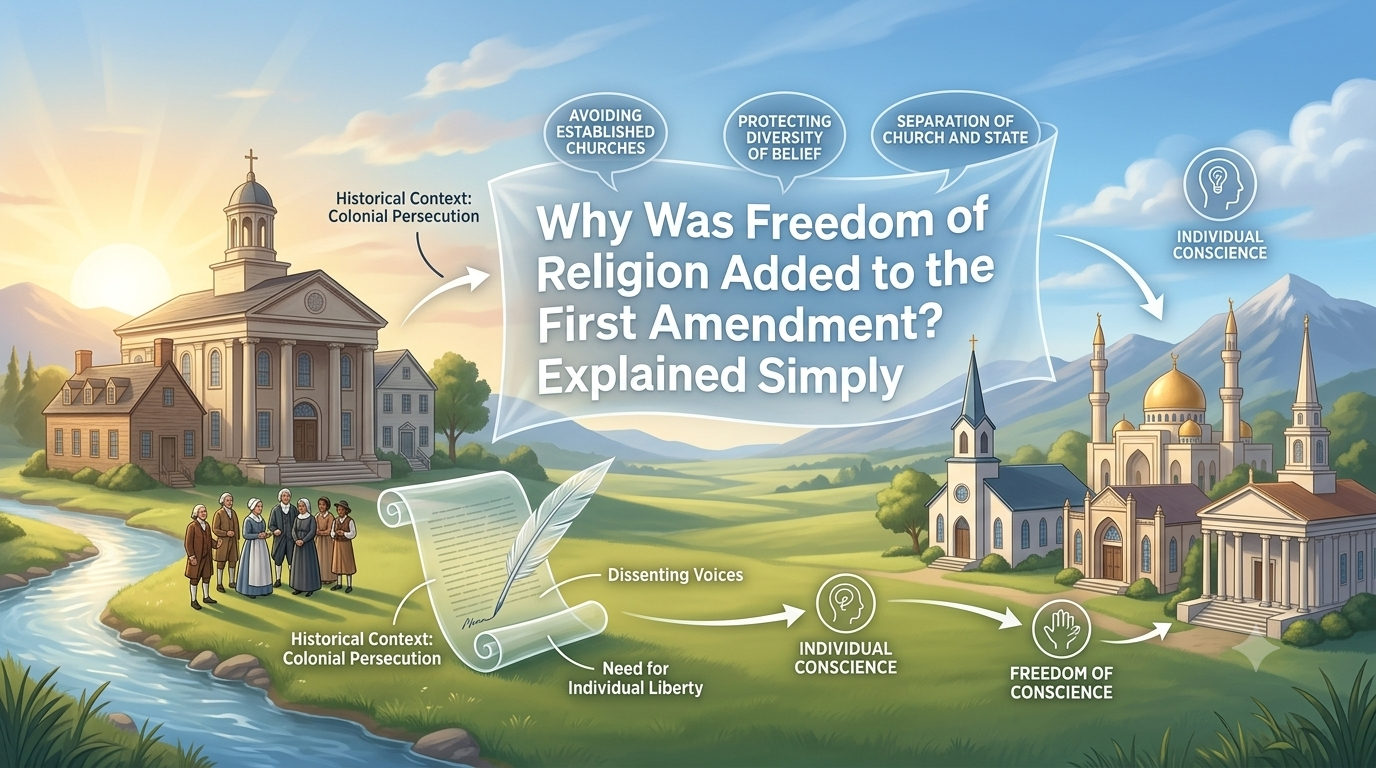
When people ask why was freedom of religion added to the First Amendment, they are usually asking a deeper question about the founding of the United States: why did the framers care so much about protecting belief? The history of such events – combined with a more general antipathy toward religious coercion — help explain why framers made religion so prominent and then specifically divided public religion from government. The clause originally stated something to the effect of ‘no law shall be made abridging the freedom of preachers or from a national church as one of the new country’s greatest guarantees.’
Why This Topic Matters
So why care about this discussion? Because understanding why was freedom of religion added to the First Amendment shows that the First Amendment wasn’t pulled out of thin air. The people who wrote it were tackling a concrete problem – they wanted a government which secured their liberty but one which didn’t repeat the religious struggles which had devastated Europe and colonial America. If they had’d overlooked this problem, we might today have some sort of official state church.
It matters for the good reason that freedom of religion helped make these other liberties more feasible to justify in America. Once the Constitution had made it acceptable to deny the government the power to oversee a conscience, it become increasingly more difficult to see what logic or legal precedent would permit government interference in speech or the press and assembly. So, from this perspective, America’s experience with the religion clauses simply is not a footnote or off shoot from its history: it is in fact one of the pillars of this nation of individual liberty. Explore more constitutional history resources in the Civics & Learning Hub.
The Historical Background
The Historical Background is easier to understand when viewed alongside the broader history of religious persecution in Europe.
The founders didn’t pull religious liberty out of thin air; it was influenced by the principles of the English Bill of Rights and constitutional history. They inherited centuries of religious-governmental struggle – much of it in Europe, where many countries imposed an official religion, often to suppress or persecute those who held a minority view. Americans also inherited practices from colonies with theocracies or state-created religions where the boundary between belief and government blurs surprisingly fast and far.
At the time the Constitution was being written, several of the American people agreed on the basic principle that this new national government should be neither too weak to exist, nor strong enough to govern religion. Anti-Federalist movements, state ratifying conventions, and all religious dissenters all lobbied for written safeguards against government intrusion upon the conscience, which they ended up adding to the Bill of Rights.
What the Founders Wanted
The text is very clear: “Congress shall make no law respecting an establishment of religion, or prohibiting the free exercise thereof.” The clause actually had two distinct, though intertwined aims. First, Congress would not be able to officially declare that the nation has an established state religion. Second, Congress was denied the power to criminalize religious belief and practice.
It was practical a bit practical as well as a philosophical compromise: A set few founders sought a clear dividing line dividing church and also state, whereas others merely did not intend the government to attack religious institutions however instead act in neutrality. What everyone definitely did concur is something really, very simple: The federal government was not to have any say in our faith.
Freedom of Religion Added to the First Amendment
In fact, the wording freedom of religion inscribed at the beginning of the First Amendment reflects the historical intent and constitutional consequence of the clause quite well. When the Framers spoke of freedom, they were hardly simply safeguarding the practice of the faith against intrusion in one’s private life. They were establishing a principle: the national government could not manipulate its political power so as as favor one faith, penalize another, or get between a genuine convert and her new one.

It’s hardly surprising that the First Amendment gave constitutional backing to this idea for, by then, America was even more ethnically diverse; various colonies already had divergent traditions, the largest share, at that time, belonged to the Lutherans but no denomination claimed universal application: only firstamendment could do that.
How the Debate Shaped the Language
But the choice of phrasing was not inadvertent. The First amendment does not, like some state declarations on official churches, simply forbid a “religion by law” as it put it in many of them. Rather it directs congress’s hands off lawmaking that either “respects an establishment of religion,” the phrase, which is thus more general and pliable than outright prohibition, in an effort to keep the federal system both from launching a church, and from mucking around with the denominational organization still functioning in some of the state governments.
It is important for two reasons. First, the Founders were establishing a federal system, not a national government. Second, the Founders wished to curb the power of the new national Congress in part while in not wholly eliminating preexisting state practices regarding religion. So a balance was reached and one to allow an America that would grow into a broader conception of Religious Liberty with that liberty intact: firstamendment.
The Two Core Protections
The free exercise and establishment clauses of the First Amendment prevent government from supporting religion or establishing a religion as the official or state sponsored form of religion of the country and the religion of the country. This protects the rights of all the citizens of the nation to exercise their religion as they please without interference or undue opposition by the government.
Together, these clauses reflect a larger principle: government should not run religion, and religion should not be controlled by government. That principle has shaped American law for centuries. It also explains why the question why was freedom of religion added to the First Amendment cannot be answered with a single sentence; it was meant to solve two problems at once.
Real-World Meaning at the Founding
From the beginning freedom of religion wasn’t a high-minded abstract expression. It made real differences in real people’s lives. For people of various faiths, it created the hope that people would be allowed to live in the republic without being forced into adopting any particular church doctrine. Moreover, it promised the government of the republic, by and large, would not endeavor through law, to shape public opinion on religious matters.
This did not mean that the nascent United States was instantly equitable or even fully open. The growth of religious liberty was slow; the ways in which different states enacted practices were not always consistent. But a distinct constitutional guarantee – that conscience, not state permission – dictated freedom of conscience – became part of the supreme law.firstamendment
Common Mistakes People Make
One common error, though, is to suppose that the First Amendment was somehow the creator of freedom of religion. The First Amendment gave constitutional weight to a concept that, prior to that time, had been in colonial and revolutionary America a subject for public, ongoing debate. A fourth, related error, occurs whenever a person regards the religion clauses as proscription of religion when historically the clause was intended to be a policy of separation of Church and State.
Pro Tips for Understanding the Clause
If you want to understand why was freedom of religion added to the First Amendment, start by reading the text slowly and separating the two clauses. The first protects against establishment; the second protects free exercise. Reading them together is the key to understanding the founders’ design.
It also doesn’t hurt to keep in mind the federal background. The wording of the amendment specifically was designed to constraine the legislature. And once you see those facts and early history, it makes some of the arguments you will see in those debates over religion and governement a bit more confusing that a simple ‘seperation’ suggests firstamendment.

And for another way to think about it, just do the comparision to other countries, look how the religion and govment combo worked with other colonial powers for an explain on why they wanted such an amendment. It was to keep the government from owning religion, and not to remove it.
A Small Case Study
An effective illustration of the goal of this amendment is a hypothetical colony or state that gives preferential treatment to one church and outlaws any other religion. In such a situation, every position of authority, source of funding, social position, and tax burden would become associated with membership in that one church. This amendment was originally penned in order to prevent this situation from being nationally applied.
This hypothetic scenario demonstrates exactly why this clause is as crucial today as it was in its infancy. It aims to protect against subtle means of pressure just as it protects against overt force. When no person is forced to belong to a church, even governmental patronage still subtly contributes to an inequitable society.
Comparison of the Two Clauses
Both have the same effect, they both work hard protecting something important on how people see and participate in religion, however the two clauses were made for separate tasks: The Establishment clause stops governments from picking or pushing a religion and the Free Exercise clause provides protection from any interference with beliefs and also religious actions.
Together this two-face policy acts like two identical parts of a constitution, stopping from both establishing or oppressing a certain religion and the strength that comes to this ensures it will survive as a part of the First Amend
What Readers Should Take Away
The clearest answer to why was freedom of religion added to the First Amendment is that the founders wanted to prevent the new government from controlling conscience. They had seen how religious power could divide societies, punish dissent, and create unfair political advantage. The amendment was their way of ensuring that religious belief would remain a matter of individual liberty rather than state command.
It also embodied a clear understanding of how a pluralistic republic must function; a society comprising citizens with differing religions requires protections for all that does not establish one faith to control the whole republic. For that reason the First Amendment remains pertinent: its protections of religious life are also protections of our civic lives.firstamendment.
Conclusion
Religion entered into the Bill of Rights on First Amendment because the nation’s creators decided government not ought dominate perception or religion, dictate religious institutions, and chastisement or encourage diversity in faith. That clause was put in the founding doc not merely ensure the republic retained its freedom but so that it could alleviate competition over spiritual concerns and recognize individual conscience.
That original decision still shapes American law and public life today. The question why was freedom of religion added to the First Amendment is really a question about how the United States chose to define freedom itself.
Quick Clarifications Questions
Why was freedom of religion included in the First Amendment?
It was included to stop the federal government from creating a national religion or interfering with people’s ability to worship freely.
What problem were the founders trying to solve?
They wanted to avoid the kinds of religious conflict and government control they had seen in Europe and in some colonial systems.
Does the First Amendment protect only churches?
No, it safeguards the more general right of religious belief, and the exercise of religion, rather than activity in a particular church.
What is the difference between establishment and free exercise?
Establishment prevents government support or favoritism for religion, while free exercise protects the individual right to practice faith.
Did the First Amendment apply to the states right away?
No. The religion clauses originally limited Congress, and the federal-state relationship on religion evolved over time.firstamendment.
Why is this still important today?
Because it protects both conscience and neutrality, helping prevent government from favoring one belief system over another.