What if a perfectly normal person, who has led a perfectly normal life just like someone else who went through a traumatic incident, begins to develop an anxiousness where the other one doesn’t? How could one event elicit different responses in different people? Concepts such as these take us into the world of healthcare, psychology, nursing, and the medical field, to explore the precipitating factors.
Odds are, you searched for “,” because you are studying for a test, prepping for clinical, or trying to understandMCQ test questions that include the term. The confusing part on how the question is phrased is the part “Which of the following is NOT a precipitating factor of”, instead of asking the option that IS a precipitating factor of.
In this guide, we unravel the concept right from scratch, understand the nature of the precipitants, differentiate it from predisposing and perpetuating factors, discuss their relevance in clinical practice, and prepare you for the exams without the need for memorization.
Understanding the Foundation
Before we get onto precipitating factors including all except means, it should be noted of the general concept that a precipitating factor means.
Precipitating Factor Anything-physical, chemical, psychological, or social-that sparks or leads directly to the initial occurrence of a disease, symptom, behavior, or a health disorder, without usually causing the basic condition.
Take a mountain that’s covered in snow for weeks; you can see how it all has built up is under pressure, unstable. All it needs is for there be one loud noise or even the slightest jerk and you get an avalanche. That’s what I would call built up pressure with its eventual trigger.
What Does “Include All Except” Mean?
One of the biggest sources of confusion comes from the wording itself.
When an exam asks:
“Precipitating factors include all except…”
it is asking you to identify the option that does not function as a trigger.
Instead of looking for what belongs in the group, you’re searching for the one choice that belongs to a different category.
For example, suppose the options are:
- Sudden job loss
- Serious infection
- Emotional trauma
- Genetic predisposition
The correct answer would usually be genetic predisposition because it is considered a predisposing factor, not a precipitating factor.
Understanding this distinction makes these questions much easier.
What Is the Difference Between Predisposing and Precipitating Factors?
Students often confuse these two concepts because both contribute to disease development, but understanding the difference between predisposing and precipitating factors makes the topic much easier to apply in healthcare.
However, they play very different roles.
| Predisposing Factors | Precipitating Factors |
| Increase long-term susceptibility | Trigger the condition |
| Usually exist before symptoms appear | Occur shortly before symptoms begin |
| May be genetic, developmental, or lifestyle-related | Often involve acute events or sudden changes |
| Do not directly start the illness | Frequently initiate symptom onset |
For example, there may be a family history of depression which raises a person’s risk over many years. He or she may experience the first depression triggered by loss of a close relative; his or her family history represents a predisposing factor to depression andBereavement is precipitating a factor.
Why Understanding Precipitating Factors Matters
Learning about precipitating factors is valuable for more than passing exams. Healthcare professionals rely on this concept every day when conducting clinical diagnostic reasoning and symptom onset evaluations, allowing them to differentiate acute triggers from long-standing health conditions.
Understanding triggers helps clinicians:
- Determine why symptoms began.
- Identify recent life events or illnesses.
- Plan treatment more effectively.
- Reduce future risk when possible.
- Differentiate between immediate and long-term causes.
For example, in a patient with a history of chronic, low-lying airway inflammation, inhalation of smoke or exposure to pollen can precipitate an acute asthmatic event. The diabetic patient with seemingly normal blood glucose will develop diabetic ketoacidosis with infection.
Key Characteristics of Precipitating Factors
Although precipitating factors vary across medical conditions, they often share several characteristics, a core analytical concept regularly emphasized across the learning guides on Education Anchor.
They Occur Close to Symptom Onset
Unlike long-standing risk factors, precipitating factors usually occur shortly before symptoms develop.
Examples include:
- A viral infection before pneumonia symptoms
- Severe emotional stress before panic attacks
- Physical trauma before acute pain
- Medication changes before adverse reactions
Timing is one of the strongest clues when identifying a precipitating factor.
They Trigger Rather Than Cause Everything
There’s usually more to disease than the precipitating event.
Like most illnesses, health problems and physical states usually involve a variety of genetic, environmental, biological and lifestyle contributors. The trigger event ( precipitating factor) is simply the one that brings about observable symptoms.
They Can Be Physical or Psychological
Not every precipitating factor involves physical illness.
Triggers may include:
Physical Events
- Infection
- Surgery
- Injury
- Medication reactions
- Hormonal changes
Psychological Events
- Divorce
- Grief
- Workplace conflict
- Major examinations
- Financial stress
Environmental Events
- Extreme temperatures
- Allergens
- Pollution
- Natural disasters
- Exposure to toxins
Each may act as a trigger depending on the person’s health condition.
Common Examples of Precipitating Factors
The easiest way to understand this concept is through practical examples.
Example 1: Heart Attack
A person may have years of coronary artery disease without symptoms.
A sudden blood clot forms and blocks an artery.
The clot becomes the precipitating factor because it immediately triggers the heart attack.
Example 2: Migraine
Some individuals are genetically prone to migraines.
However, the headache itself may begin after:
- Lack of sleep
- Bright lights
- Certain foods
- Hormonal changes
- Emotional stress
These are precipitating factors because they trigger migraine episodes.
Example 3: Anxiety Disorder
Someone may have a biological tendency toward anxiety.
After beginning a highly stressful new job, they experience their first panic attack.
The stressful life event functions as the precipitating factor.
Example 4: Asthma
A person with chronic asthma may remain symptom-free for weeks.
After exposure to pollen or cigarette smoke, breathing difficulties suddenly begin.
The allergen serves as the precipitating factor.
Example 5: Type 2 Diabetes Complications
The patient has diabetes well under control. He gets the flu. High-level hyperglycemia causes acute high blood sugar, forcing admission to hospital. The influenza virus infection served as precipitating agent for the acute episode.
Understanding the “All Except” Format
Multiple-choice questions often test your ability to distinguish between similar concepts.
Suppose the question asks:
Precipitating factors include all except:
A. Emotional trauma
B. Acute infection
C. Family history of schizophrenia
D. Major surgery
The correct answer is:
C. Family history of schizophrenia
Why?
Because family history increases susceptibility over time but does not directly trigger symptom onset.
Precipitating Factors Include All Except: A Complete Educational Guide
Breaking Down Related Concepts
When answering precipitation questions, another cause for concern occurs in several different textbooks, licensing examinations, psychology, or medical programs where there are several similar words clustered in a specific context, as well they are similar in the form and meaning of words describe different stage a precipitating illness.
Understanding how these concepts connect is far more valuable than memorizing definitions.
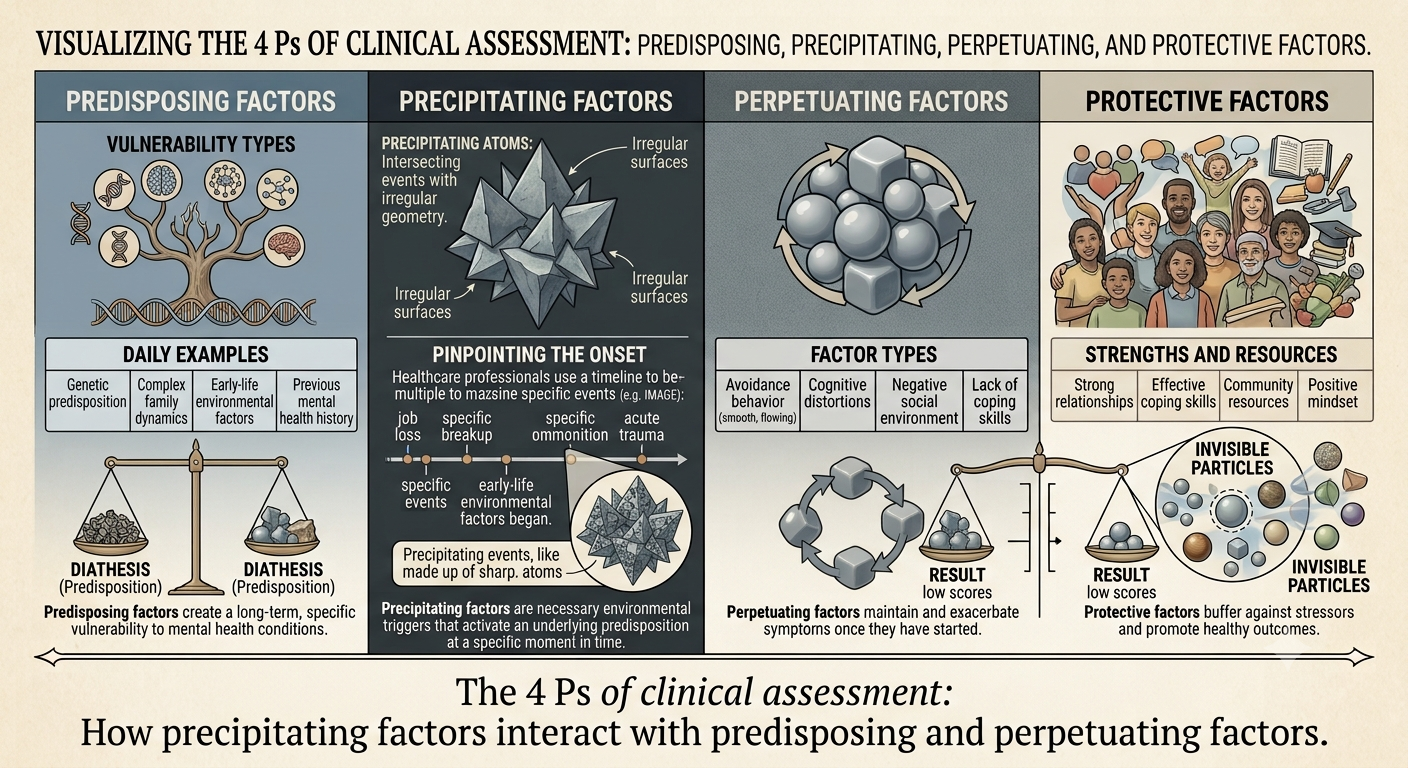
| Concept | Meaning | Example |
| Predisposing factor | Increases a person’s long-term risk of developing a condition | Family history of depression |
| Precipitating factor | Triggers the onset of symptoms | Loss of a loved one leading to the first depressive episode |
| Perpetuating factor | Keeps the condition going or makes recovery more difficult | Ongoing social isolation that worsens depression |
| Protective factor | Reduces risk or supports recovery | Strong family support or effective coping skills |
Think of it like building a campfire.
- Dry wood represents the predisposing factor because it makes a fire easier to start.
- A lit match is the precipitating factor because it ignites the fire.
- Wind that keeps the flames burning acts as a perpetuating factor.
- Water or a fire extinguisher serves as a protective factor.
This comparison helps explain why precipitating factors are considered immediate triggers rather than underlying causes.
How Precipitating Factors Work in Healthcare
When trying to figure out why a person got sick, healthcare providers very rarely consider one sole cause. They investigate how and why everything relates to one another: A person could have a chronic illness for decades and not notice any symptoms but a series of triggering events that causes a previously undiscovered illness to flourish.
For example:
- A patient with chronic heart disease develops chest pain after extreme physical exertion.
- A person with epilepsy experiences a seizure after several nights of poor sleep.
- Someone with chronic lung disease develops severe breathing problems after catching influenza.
In each situation, the underlying illness already existed. The precipitating factor simply brought it to the surface.
Common Categories of Precipitating Factors
Although triggers differ from one condition to another, they generally fall into several broad categories.
Physical Triggers
Many illnesses become symptomatic after physical stress placed on the body.
Examples include:
- Infections
- Surgery
- Physical injuries
- Sleep deprivation
- Severe dehydration
- Hormonal fluctuations
- Certain medications
These events can disturb the body’s normal balance and trigger existing conditions.
Emotional and Psychological Triggers
Mental health conditions often involve psychological precipitating factors.
Examples include:
- Death of a family member
- Divorce
- Relationship conflict
- Academic pressure
- Workplace stress
- Financial hardship
- Exposure to traumatic events
Not everyone exposed to these experiences develops a mental health disorder. Individual vulnerability still plays an important role.
Environmental Triggers
Changes in the environment can also act as precipitating factors.
Examples include:
- Exposure to allergens
- Air pollution
- Extreme temperatures
- Natural disasters
- Loud noise
- Poor air quality
These factors are especially important in respiratory diseases, allergies, and some neurological conditions.
Clinical Examples Across Different Conditions
Studying examples from different medical fields helps reinforce the concept.
Depression
Predisposing factor:
A strong family history of mood disorders.
Precipitating factor:
The unexpected loss of employment.
Perpetuating factor:
Continued unemployment and social withdrawal.
Asthma
Predisposing factor:
Chronic airway inflammation.
Precipitating factor:
Exposure to pollen during spring.
Perpetuating factor:
Continued exposure without treatment.
Peptic Ulcer Disease
Predisposing factor:
Long-term infection with Helicobacter pylori or frequent use of NSAIDs.
Precipitating factor:
A medication that irritates the stomach lining or another acute physiological stressor.
Perpetuating factor:
Continuing the harmful medication without medical guidance.
Panic Disorder
Predisposing factor:
Inherited tendency toward anxiety.
Precipitating factor:
A highly stressful life event.
Perpetuating factor:
Avoiding everyday situations due to fear of future panic attacks.
Why Timing Matters
One of the easiest ways to identify a precipitating factor is to ask:
“What happened immediately before the symptoms began?”
This question is commonly used in healthcare assessments because timing often provides valuable clues.
For example:
When a person shoveling heavy snow is later experiences a severe case of chest pain it is not an accumulation of plaque which has been ongoing for years which directly causes it; the event of recent physical activity immediately prior to the onset of chest pain perhaps. So too a patient who may have suffered form perfectly regulated epilepsy all of his or her life could go on have a full-blown seizure after a few extremely uncomfortable night sleep.
The trigger occurs close to symptom onset.
Common Exam Question Patterns
Many nursing, psychology, and health science examinations test this concept using multiple-choice questions.
Here are several examples.
Example 1
Precipitating factors include all except:
A. Acute infection
B. Emotional trauma
C. Family history of bipolar disorder
D. Major surgery
Correct answer: C
Family history is a predisposing factor rather than a precipitating factor.
Example 2
A patient develops an asthma attack after exposure to cigarette smoke.
The precipitating factor is:
A. Genetic susceptibility
B. Airway inflammation
C. Cigarette smoke exposure
D. Childhood asthma history
Correct answer: C
The smoke exposure directly triggered the attack.
Example 3
A student with an inherited anxiety tendency experiences panic attacks during final examinations.
The precipitating factor is:
A. Family history
B. Genetics
C. Examination stress
D. Personality traits
Correct answer: C
The exams acted as the immediate trigger.
Mistakes Students Frequently Make
Understanding common errors can help you answer questions more confidently.
Mistake 1: Confusing Risk Factors with Triggers
A risk factor means something that make the possibility of the condition more likely to occur as time goes by. A precipitating factor is what actually sets off the episode. For example, obesity is risk for some diseases, but there is no guarantee it triggers acute episode at some particular juncture.
Mistake 2: Assuming Every Stressful Event Is a Precipitating Factor
A precipitating factor must cause symptoms. It does not have to be a negative or traumatic event. Many different kinds of stressful circumstances are potential precipitators provided that circumstances the person is experiencing actually prompt symptoms in them. A factor that predates the occurrence of symptoms by several years more probable to be the cause of onset than a fact that precipitated onset shortly prior.
Mistake 3: Ignoring Context
The same event might be causing the condition in one patient and not the other. Let’s say, for instance, breathing in pollen causes an asthma attack to a patient that is allergic to it, but to a patient without sensitivity in the respiratory system, there will be no effect on it. In that regard, along with the triggering factors, doctor also keep that into consideration while assessing the history of patient.
Expert Learning Tip
When you see the phrase “precipitating factors include all except,” mentally replace it with:
“Which option is NOT an immediate trigger?”
This simple strategy shifts your thinking away from memorization and toward understanding, making exam questions much easier to solve.
Precipitating Factors Include All Except: A Complete Educational Guide
Applying the Concept in Real-World Healthcare
In reality precipitating factors have value far beyond their application as a multiple-choice test question. Almost every healthcare practitioner is considering the patient’s precipitating factors as he works on a patient in daily practice, weighing the causes and potential treatments.
They don’t ask merely, “What is wrong with this patient?”, but “What incident provoked the symptoms that have brought this patient here today? “This separates the actual cause of illness from the precipitating event.
For example, a person who has had high blood pressure for years without any signs, quits taking his prescribed medication only to end up with a hypertensive crisis soon thereafter. Untreated hypertension is the problem and withdrawal from the medication is a precipitator.
Case Studies to Build Understanding
Working through realistic scenarios helps reinforce the difference between predisposing and precipitating factors.
Case Study 1: Major Depressive Disorder
A 42-year-old teacher has a family history of depression but has never experienced symptoms. After unexpectedly losing a close family member, they begin experiencing persistent sadness, loss of interest, difficulty sleeping, and fatigue.
Analysis
Predisposing factor:
- Family history of depression
Precipitating factor:
- Death of a loved one
Perpetuating factors:
- Social withdrawal
- Poor sleep
- Lack of counseling
This example illustrates how a vulnerability may remain inactive until a triggering event occurs.
Case Study 2: Asthma
This is in the child with well-controlled chronic asthma treated with medication. If at school in the spring the child goes outside for many hours when pollens are high. The child then experiences shortness of breath and wheezing later on.
Analysis
Predisposing factor:
- Chronic asthma
Precipitating factor:
- Heavy pollen exposure
Perpetuating factor:
- Continued allergen exposure without treatment
Case Study 3: Type 2 Diabetes
An adult with controlled diabetes develops influenza.
Within several days, blood glucose levels become dangerously elevated.
Analysis
Predisposing factor:
- Diabetes mellitus
Precipitating factor:
- Viral infection
Perpetuating factor:
- Delayed medical treatment
Why One Trigger Affects One Person but Not Another
One of the most fascinating aspects of healthcare is that people respond differently to the same event.
Two coworkers may experience identical workplace stress.
- One develops anxiety symptoms.
- The other continues functioning normally.
Why?
Because precipitating factors do not work in isolation.
Their effect depends on several interacting influences, including:
- Genetics
- Overall health
- Previous illnesses
- Coping skills
- Lifestyle habits
- Social support
- Existing medical conditions
Healthcare providers therefore avoid assuming that every stressful event will affect everyone equally.
Common Misconceptions About Precipitating Factors
Many students misunderstand this concept because several similar terms are introduced together.
Let’s correct some of the most common misconceptions.
Misconception 1: A Precipitating Factor Always Causes the Disease
Not exactly.
In many cases, the disease already exists or the person already has an underlying susceptibility.
The precipitating factor simply triggers the first noticeable symptoms or an acute episode.
Misconception 2: Every Risk Factor Is a Precipitating Factor
This is one of the most common examination mistakes.
For example:
- Smoking increases the risk of lung disease.
- Family history increases genetic susceptibility.
- Aging increases the likelihood of many conditions.
These are usually risk factors or predisposing factors, not precipitating factors.
Misconception 3: Precipitating Factors Are Always Psychological
Although psychology frequently discusses precipitating events, they occur throughout medicine.
Examples include:
- Infection
- Surgery
- Medication interactions
- Allergic reactions
- Physical trauma
- Hormonal changes
The concept applies across nearly every healthcare discipline.
How to Answer “Precipitating Factors Include All Except” Questions
Multiple-choice questions often become much easier when you use a structured approach.
Step 1: Identify the Immediate Trigger
Ask:
Did this event happen shortly before symptoms appeared?
If yes, it may be a precipitating factor.
Step 2: Look for Long-Term Conditions
Ask:
Has this factor existed for months or years?
If so, it is more likely to be a predisposing or risk factor.
Step 3: Eliminate Incorrect Categories
Options involving:
- Genetics
- Family history
- Age
- Sex
- Chronic susceptibility
are commonly included as distractors because they increase risk but do not directly trigger symptom onset.
Step 4: Focus on Timing
Timing is often the deciding clue.
Immediate events usually represent precipitating factors.
Long-standing characteristics usually do not.
Memory Trick for Students
A simple memory aid can make this concept easier to remember.
P = Pushes the Problem Into Action
Think of the letter P in precipitating.
It reminds you that the trigger pushes the condition into becoming noticeable.
Meanwhile:
- Predisposing = prepares the possibility.
- Precipitating = pushes it to happen.
- Perpetuating = prolongs the problem.
- Protective = prevents or reduces the problem.
Many nursing and psychology students find this sequence much easier to remember than isolated definitions.
Key Points to Remember
Before moving on, review the central ideas from this lesson:
- Precipitating factors are immediate triggers.
- They often occur shortly before symptoms appear.
- They are different from long-term risk factors.
- Family history is usually not a precipitating factor.
- Genetics increase susceptibility but rarely trigger sudden episodes directly.
- Physical, emotional, environmental, and medical events may all act as precipitating factors.
- Understanding timing is essential for identifying the correct answer in examinations.
Conclusion
If you’ve ever been confused by the phrase “precipitating factors include all except,” the key is to focus on what the question is really asking. Instead of searching for events that contribute to disease in general, you need to identify which option is not an immediate trigger.
Precipitating factor – An event or conditions that cause a symptom or condition. Unlike predispositions, which make you susceptible over time or exacerbators, which continue after the illness starts.
So whether you are a nursing, psychology, medicine, or other health science student, knowing this distinction will help you perform both clinically and on your exams. Instead of trying to memorize specific examples, try to teach yourself to ask “Did the event cause symptoms or did it increase the risk that the person would have symptoms?” Knowing the answer will help you correctly solve “all but” type questions.
Frequently Asked Questions (FAQs)
1. What does “precipitating factors include all except” mean?
This sentence is found frequently in multiple choice tests. It implies you should identify which is the option that isn’t a precipitating agent, and because precipitating agent means it is what makes the symptoms occur, often the right answer includes a gene or something with long term effect, or family history.
2. What is the difference between a precipitating factor and a predisposing factor?
A predisposing factor makes a person more susceptible to developing a condition over time, while a precipitating factor is the event that triggers the onset of symptoms.
For example:
- Family history of depression = Predisposing factor
- Death of a loved one leading to the first depressive episode = Precipitating factor
The first increases vulnerability, while the second acts as the trigger.
3. Can one condition have more than one precipitating factor?
Yes. Many health conditions have multiple possible triggers.
For instance, an asthma attack may be precipitated by:
- Pollen exposure
- Respiratory infections
- Cigarette smoke
- Exercise
- Cold air
- Air pollution
The exact precipitating factor depends on the individual’s medical history and the circumstances surrounding the episode.
4. Are precipitating factors always preventable?
Sometimes not. Certain triggers like an infection or an unforeseen traumatic event may be very difficult or impossible to avoid. Recognizing common precipitating factors however will enable the health care professional and the patient to minimize avoidance of avoidable triggers when ever it seems possible to do so.
For instance, a patient with asthma may avoid recurrent attacks by steering clear of tobacco smoke and adhering to a medication schedule.
5. Why do nursing and psychology exams ask about precipitating factors?
What kind of cause am I dealing with here? This section will check to make sure you can identify types of causes as opposed to recalling what something meant. For those of you, as future physicians will need to answer whether the factor is a risk factor, precipitating event, or what makes it last longer.
6. Can psychological stress be a precipitating factor?
Yes. Emotional stress is one of the most common precipitating factors in mental health.
Examples include:
- Bereavement
- Divorce
- Workplace conflict
- Academic pressure
- Financial difficulties
- Exposure to traumatic events
However, stress does not affect everyone in the same way. Individual vulnerability and protective factors influence how a person responds.
7. How can I quickly identify the correct answer on an exam?
Ask yourself one simple question:
“Did this happen immediately before the symptoms started?”
If the answer is yes, it is more likely to be a precipitating factor.
If the option describes something that has existed for years—such as genetics, age, or family history—it is usually not a precipitating factor.
This strategy works well for nursing, psychology, medical, and allied health examinations.
Final Summary
Understanding “precipitating factors include all except” requires more than memorizing textbook definitions. It involves recognizing how different factors contribute to disease development over time.
This has the important lesson that ‘ precipitating’ causes or factors are immediate triggers, that act or present shortly prior to the noticeable onset and make that illness apparent now. Conversely, predisposing or contributory and perpetuating factors work over the lifetime or are a chronic influence once disease presents.
Once you shift your thinking towards concepts of timing, context and correlation between predisposing vulnerability and precipitating factors you’ll be far more relaxed and certain of answering exam questions with greater confidence in your understanding of real life clinical reasoning. In fact this could even be seen as relevant reading for anyone concerned about where physical or psychological illnesses and disorders stem from.