When students begin studying cells for the first time they hear that prokaryotes and eukaryotes are vastly distinct organismal groupings. One category consists of basic no-nucleus cells, the other one does. With that distinction one can imagine that these two living things have nothing in common.
However, the answer to what do prokaryotes and eukaryotes have in common reveals something much deeper about biology: Even though billions of years of evolution separate these cells, there are still many of the same basic cellular process that all living things need in order to survive, grow, and multiply. Prokaryotes and eukaryotes utilize these cellular and biological process even with their distinct differences.
No matter whether it’s bacteria growing in the extremes of the earth or eukaryotic cells in our human bodies, all forms of life utilizes similar process: the utilization of genetics, protein production, interior conditions maintained, and the creation of energy through different processes all point to the unity of cells on earth. But learning this isn’t just for biology students: this helps teach scientists how animals and organisms reproduce, the processes of sickness and disease, the technologies of genetic science, and why cells are the smallest form of life.
The Bigger Picture: Why Comparing Cell Types Matters
Every living organism is built from cells, but not every cell is organized in the same way. Scientists generally divide cellular life into two major categories: prokaryotes and eukaryotes.
Prokaryotes such as bacteria and archaea generally have smaller and less organized structures. They do not have a nucleus that’s enclosed by a membrane, which allows their genetic materials (DNA) to freely float within a region called the nucleoid. Eukaryotes such as animals, plants, and fungi include microorganisms as well, their cells have a membrane-bound nucleus and specialized compartment or organelles that carry out a particular function.
From initial viewing, it looks like two very different kinds of life – say a cell that belongs to a person, with its nucleus, mitochondria and cellular transportation system, it couldn’t be more distant from a single little cell that represents a bacterium.
It turned out however that both have got certain fundamental features that allow a cell to exist. These features let us determine how the primordial life evolve and also to figure out that modern beings are evolved from primordial cellular prototypes.
What Do Prokaryotes and Eukaryotes Have in Common?
Although prokaryotic and eukaryotic cells have different levels of complexity, they share several important biological characteristics.
Both Are Made of Cells
Both Are Made of Cells and follow the principles of cell theory in biology. The most basic similarity is that both prokaryotes and eukaryotes follow the principles of cell theory. This scientific concept states that:
- All living things are made of one or more cells.
- The cell is the basic unit of life.
- New cells come from existing cells.
However regardless if its a large whale or microscopic bacteria, when it gets to the cellular level, all of life starts in a cell. They’re vastly different in size in a human compared to bacterium up close, however the principles for both the systems functioning individually and collectively still apply.
Both Contain Genetic Material
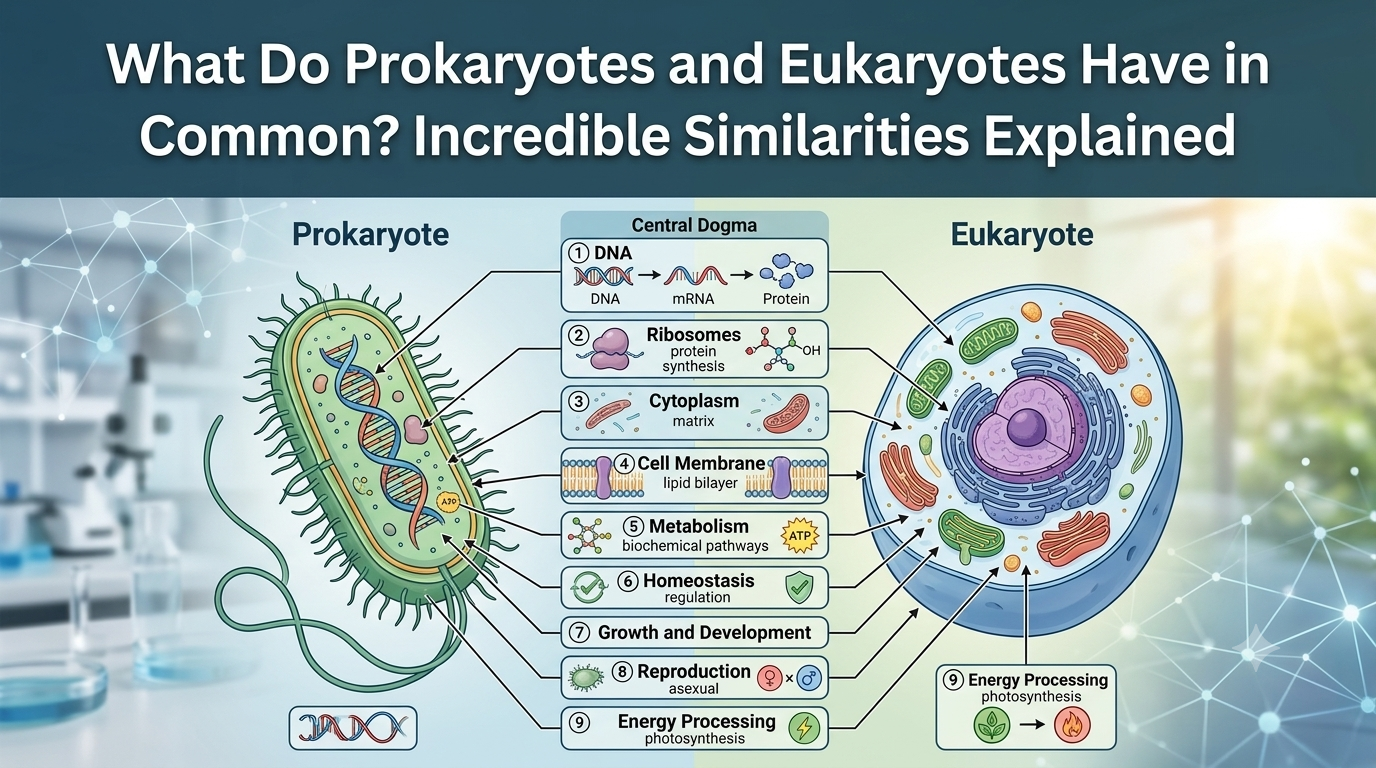
One major thing prokaryotic and eukaryotic cells have in common is both have DNA. DNA, or deoxyribonucleic acid, it’s the blueprints of how to make and run a living thing. There is DNA within them that has information to making products, or genes, as the information of making a cell run.
The reason DNA is different between the two, is its arrangement.
In prokaryotes:
- DNA is located in the nucleoid region.
- It is usually a single circular chromosome.
- Additional small DNA molecules called plasmids may also exist.
In eukaryotes:
- DNA is enclosed inside the nucleus.
- It is organized into multiple linear chromosomes.
- Genetic material is packaged with proteins called histones.
Despite these differences, the basic role of DNA remains the same: storing and passing genetic information from one generation to another.
Both Use Ribosomes to Produce Proteins
Another key thing these cells have in common: making protein Protein making is one primary similarity between eukaryotic and prokaryotic cells. Why? Protein has all the world’s jobs inside the cells like acting as structural integrity, transporting, signals, and carrying our work for example, enzymes, carry. Eukaryotic cells, just like prokaryoticcells have ribosoome, tiny workers inside translating DNA codes to aminoacid chain for proteins!
The process involves:
- DNA containing genetic instructions.
- Messenger RNA (mRNA) carrying those instructions.
- Ribosomes assembling amino acids into proteins.
Although there are subtle differences in prokaryotic and eukaryotic ribosome size and complexity, the process is otherwise very similar. The conserved nature of this mechanism helps indicate that the process of gene expression is a fundamental and ancient one that was conserved throughout life.
Both Have a Cell Membrane
Every living cell must have a membrane separating it from its surroundings and its environment. In both prokaryotic and eukaryotic cells a cell membrane also referred to as the plasma membrane is used to carry out the processes that take place on or in a cell. As well as creating physical separation of cell materials the cell membrane’s main role, as part of cellular homeostasis is to regulated transport across the cell membrane and permit nutrients within, waste products out and assist maintain of equilibrium throughout cells inner surrounding.
The membrane is primarily made of:
- Phospholipids
- Proteins
- Other molecules that support communication and transport
This structure is sometimes described as a selectively permeable barrier because it carefully regulates movement of substances.
Without this protective boundary, cells would not be able to maintain the organized environment required for life.
Both Perform Metabolism to Obtain Energy
Living organisms need energy to survive, and both prokaryotic and eukaryotic cells carry out metabolism.
Metabolism refers to the collection of chemical reactions that occur inside cells. These reactions allow organisms to:
- Obtain energy from nutrients
- Build necessary molecules
- Remove waste
- Maintain cellular functions
Both cell types use molecules such as ATP (adenosine triphosphate) as an energy currency.
ATP provides usable energy for activities including:
- Movement
- Chemical reactions
- Cell growth
- Repair processes
It doesn’t really matter how you go about it to keep principles the same. For example, several organisms use cellular respiration or fermentation, but many eukaryotes depend extensively on their mitochondria for energy generation.
Both Maintain Homeostasis
Another important similarity is the ability to maintain homeostasis, which means keeping internal conditions stable.
Cells must regulate factors such as:
- Temperature
- Water balance
- Chemical concentrations
- Energy levels
Even the simplest bacterial cells change themselves as soon as their environment changes. Human cells do it in the same fundamental way, but rely on networks of tissues, organs or other cells to tell them whether to change anything about themselves. If you want your cells to perform certain jobs, they need to be under certain environmental conditions.
Both Reproduce and Pass Genetic Information
To reproduce Prokaryotic and eukaryotic unicellular or multicellular organisms duplicate themselves, thus making their copies and passing on gene. A commonly occurring means of reproducing among prokaryotes is binary fission in which the cell splits into the production of two identical offspring.
Eukaryotic cells reproduce through processes such as:
- Mitosis for growth and repair
- Meiosis for producing reproductive cells
The methods are different, but both systems ensure that genetic information continues from one generation to the next.
This ability to reproduce is one of the defining characteristics of life.
The Shared Cellular Machinery Behind Different Forms of Life
It’s the internal similarity of structures, too, between the human cell and the bacterium that interests the scientists the most. From outward appearances, it’s possible the structures could be very far apart, yet underlying biochemistry suggests strong relations in this other sense.
For example, both groups use:
- DNA replication to copy genetic information
- RNA molecules to transfer instructions
- Ribosomes to build proteins
- Enzymes to control chemical reactions
- ATP molecules for energy transfer
Their overlapping and complex machinery hints that complex life today adopted much of their fundamental biochemical apparatus from far distant forebears. The scientific name for biological trait in this sense (like the basic biochemical processes that produce energy or use other life sources), is evolutionary conservation. If such a system or pathway is retained over the course of millions or billions of years, this nearly always mean that it has been quite successful.
Evolutionary Connection Between Prokaryotes and Eukaryotes
This connection between prokaryotes and eukaryotes gives us major clues into the history of life on our planet. Today, it is known by the scientific world that prokaryotic organisms likely began to dominate the planet long before eukaryotes did. Prior to the formation of our complex eukaryotic organisms, our planet may have been populated primarily with simple single cells.
The endosymbiotic theory of eukaryotic cell evolution is one prominent hypothesis for the origin of some eukaryotic cell parts.
It implies that some structures in eukaryotic cells- particularly mitochondria and chloroplasts- came from old bacteria that partnered with initial cells.
Evidence supporting this idea includes:
- Mitochondria and chloroplasts contain their own DNA.
- They reproduce independently within cells.
- Their ribosomes resemble those found in bacteria.
This connection shows that the boundary between prokaryotic and eukaryotic life is not simply a divide. Instead, it represents a long evolutionary journey shaped by adaptation and cooperation.
Major Differences Between Prokaryotic and Eukaryotic Cells
To understand what’s same about the organisms we call prokaryotes and the organism we call eukaryotes we need to see how their differences fit into context: -the similarities highlight their common ancestry, and the differences account for the organism that has been “concocted”.
The most significant distinction is the presence of a membrane-bound nucleus.
| Feature | Prokaryotic Cells | Eukaryotic Cells |
| Nucleus | No true nucleus; DNA is located in the nucleoid region | DNA is enclosed inside a nucleus |
| Cell Size | Usually smaller, often about 0.1–5 micrometers | Usually larger, often about 10–100 micrometers |
| DNA Structure | Usually circular chromosome | Multiple linear chromosomes |
| Organelles | Lack membrane-bound organelles | Contain organelles such as mitochondria and Golgi apparatus |
| Cell Division | Binary fission | Mitosis and meiosis |
| Examples | Bacteria and archaea | Animals, plants, fungi, and protists |
These distinctions however, are not indicating a difference of advanced vs primitive. Prokaryotes have managed to persist on earth for literally billions of years with very simple structures simply because the simple structure is very effective for its purpose. Bacteria in general, are able to rapidly reproduce, they are very adaptable to new conditions, and are able to live where a more sophisticated life form could never survive.
However, the other cells eventually developed the kind of intracellular structures that made eukaryotic organisms to become complex, and able to be made out of many cells working together.
Common Misunderstandings About Prokaryotes and Eukaryotes
Many people learn the basic differences between these cell types but develop incorrect assumptions about what those differences mean.
Misconception 1: Prokaryotes Are Primitive or Less Successful
Misconceptions often revolve around what many see as the “primitive” nature of prokaryotes – due to the lack of a nucleus. Such views are however, wrong in many respects. Prokaryotes are not in any way ‘less’ complete than a eukaryote.
Bacteria can:
- Communicate with other cells through chemical signals
- Exchange genetic material
- Develop resistance mechanisms
- Survive extreme temperatures, acidity, and pressure
Their smaller size and simpler organization often provide advantages, including faster reproduction and efficient resource use.
Misconception 2: Only Eukaryotes Have Complex Functions
Another misunderstanding is that complexity only exists in eukaryotic organisms.
While eukaryotic cells contain more visible structures, prokaryotes perform many advanced biological functions.
For example, some bacteria can:
- Convert sunlight into energy
- Fix nitrogen from the atmosphere
- Break down environmental pollutants
- Form cooperative communities called biofilms
The complexity of life is not determined only by the number of organelles inside a cell.
Misconception 3: Prokaryotes and Eukaryotes Are Completely Unrelated
Although they have major differences, they are connected through evolutionary history.
Both rely on the same fundamental biological language:
- DNA stores information.
- RNA transfers instructions.
- Ribosomes create proteins.
- Cells use energy molecules to function.
These similarities reveal that life shares a common molecular foundation.
Why These Similarities Matter in Modern Science
The similarities between prokaryotic and eukaryotic cells are not just concepts found in biology textbooks. They influence research, medicine, biotechnology, and environmental science.
Medical Research and Human Health
Scientists study bacteria and human cells together because many cellular processes are shared.
For example, researchers examine bacterial systems to understand:
- How genes function
- How proteins are produced
- How cells respond to environmental changes
Furthermore, learning differences between prokaryotic and eukaryotic cells also gives humans the insight to make new treatments that only harm bad bacterial cells and leave the human cells innocent! Bacteria is where an antibiotic can prevent and stop people like ourself being eaten and or sickened by these awful microorganisms. As far as antibiotics go, certain treatments hinder the production of protein specifically within bacterial structures instead of with human ones.
Biotechnology Applications
The shared mechanisms of cells have allowed scientists to develop powerful technologies.
Modern biotechnology uses knowledge of both prokaryotic and eukaryotic systems for:
- Producing medicines
- Creating genetically modified organisms
- Manufacturing enzymes
- Studying genetic diseases
For instance, bacteria can be genetically engineered to manufacture human proteins. Specific gene fragments of a human can be implanted inside a bacterium and then the bacterium will be engineered to make needed substances.
Understanding Evolution and Biodiversity
Comparisons like this between these two types of cell can tell scientists how life has evolved. They have come from an understanding of that early prokaryotic world and the later eukaryotes evolve out of the prokaryotes, and the similarities tell them how the complexity of life evolved. These common features show that nature usually refines what already there.
Practical Examples of Prokaryotes and Eukaryotes in Everyday Life
The differences and similarities between these cells appear throughout daily life.
Bacteria in Food Production
Many prokaryotes play beneficial roles in food production.
Examples include bacteria involved in:
- Yogurt fermentation
- Cheese production
- Pickling processes
These organisms convert substances into useful products through metabolic activities.
Microorganisms in the Human Body
The human body contains trillions of microorganisms, many of which are bacteria.
These prokaryotic organisms interact with human eukaryotic cells in ways that influence:
- Digestion
- Nutrient processing
- Immune system development
This relationship shows that different types of cells can work together within complex ecosystems.
Plants and Animals
Plants and animals are made of eukaryotic cells containing specialized structures.
A plant cell contains features such as:
- Chloroplasts for photosynthesis
- A cell wall for structural support
- A large central vacuole for storage
Animal cells contain structures that allow movement, communication, and specialized functions.
Despite these differences, both still depend on the same basic cellular principles shared with prokaryotes.
How Scientists Study Similarities Between Cell Types
Researchers use many techniques to compare prokaryotic and eukaryotic organisms.
Some important methods include:
Microscopy
Microscopes allow scientists to observe cellular structures.
Advanced imaging techniques help researchers study:
- Cell membranes
- Organelles
- Chromosomes
- Microbial communities
Genetic Analysis
Now it is possible for researchers to compare dna evidence in different species. Scientists examine the many genes by species and to find connections between organisms and the origin of systems of the cell.
Molecular Biology Experiments
Scientists study individual cellular processes by examining molecules such as:
- Proteins
- DNA
- RNA
- Enzymes
These experiments reveal how similar mechanisms operate across different organisms.
The Importance of Learning Cellular Similarities
The Importance of Learning Cellular Similarities Explore more biology, science, and educational resources on the Education Anchor.
Understanding what do prokaryotes and eukaryotes have in common provides a foundation for studying nearly every area of biology.
Students who understand these shared characteristics can better understand topics such as:
- Genetics
- Evolution
- Microbiology
- Human health
- Environmental science
More significantly though, these similarities serve as a vital reminder of one central biological concept-that there is great variety in life, but that in fact there are many processes that lie at its very foundation. Whether bacteria living in soil or individual cells in your own body, they may reside in profoundly different places but both owe themselves to an identical set of underlying biological constraints.
Final Thoughts: The Common Threads That Connect All Life
The answer to what do prokaryotes and eukaryotes have in common goes beyond a simple list of similarities. Both cell types represent different solutions to the same biological challenge: maintaining life.
All life depends on these processes, including protein-coding genetics, protein production via ribosomes, the presence of cell membranes, energy creation, homeostasis, and reproduction. All these factors point toward a profound connectedness of life forms to each other. While differences in prokaryotic and eukaryotic life shed light on biological complexity and evolution in a major way, their similarities highlight a fundamental connection that exists at the basis of that diversity. From bacteria to animals and the whole plant kingdom, all life forms are grounded in the cellular processes evolved across the planet over billions of years of time.
Frequently Asked Questions
1. What is the main similarity between prokaryotic and eukaryotic cells?
The two major similarities are that they both possessDNA, have membranes around them, and employ ribosomes in building protein. They both carry out vital processes needed for survival, including metabolism, and having babies.
2. Do prokaryotes and eukaryotes have the same DNA?
Yes, but DNA is organised very differently. DNA is present in an organised, circular structure within the nucleus (nucleoid region) of prokaryotes whereas that in eukaryoticcells is organised in a linear fashion within the nucleus.
3. Are bacteria prokaryotes or eukaryotes?
Bacteria is a Prokaryote A prokaryote (prokaryon: “before kernel”), is single-celled, like the bacterium or bacterium with an absence of a nucleus, other than these special cases listed below, most Prokaryotes don’t have other specialized organelles and are very small cells, no longer than 2microns
4. Why are ribosomes found in both prokaryotic and eukaryotic cells?
Ribosomes are found in both because all cells need to produce proteins. They translate genetic instructions into proteins required for survival and function.
5. Did prokaryotes evolve before eukaryotes?
Based on current scientific evidence, prokaryotic organisms appeared much earlier in Earth’s history. Eukaryotic cells developed later and gained more complex internal structures.
6. Can prokaryotes and eukaryotes live together?
Yeah. Yes, most all ecosystems will have both of kinds of these organisms. If you think about most any environment, such as an ocean or soil or a human being, bacteria coexists with plants and animals and even fungi in that environment.
7. What feature separates prokaryotes from eukaryotes?
The primary difference is that eukaryotic cells contain a membrane-bound nucleus, while prokaryotic cells do not.