Students studying psychology often encounter the question “which of the following is an example of a diathesis-stress model?” in textbooks, classroom discussions, and exams. While it may initially appear to be a simple multiple-choice question, understanding the correct answer requires a deeper knowledge of one of psychology’s most influential theories of mental health.
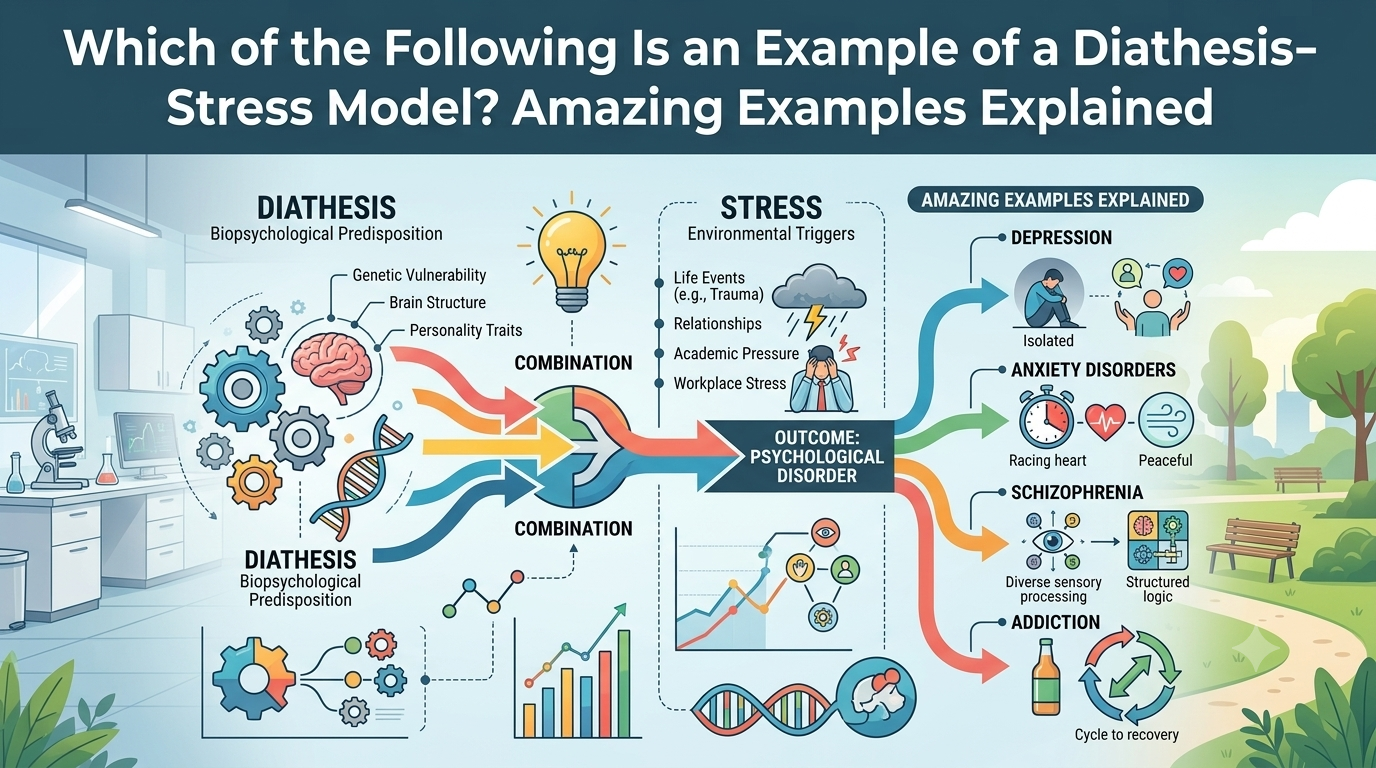
The diathesis-stress model states that psychologists tend to think psychological disorders generally result from the interaction of two principal variables: the diathesis (underlying predisposition in an individual) and environmental and/or major life events (stressor). The model posits that you must look at both genetics and experience to see which contributes to the probability of having particular mental disorders.
Understanding which of the following is an example of a diathesis-stress model? is valuable not only for students preparing for exams but also for anyone interested in how biology, environment, and personal experiences work together to influence emotional well-being. Explore more educational learning resources and study guides on Education Anchor for additional academic explanations across psychology and other subjects. This guide explains the model in straightforward language, provides practical examples, discusses common misconceptions, and explores how the concept is used in modern psychology.
What Is the Diathesis-Stress Model?
Understanding the biopsychosocial model in psychology alongside the diathesis-stress model helps explain how biological, psychological, and environmental factors influence mental health.
Before answering which of the following is an example of a diathesis-stress model?, it’s important to understand what the theory actually proposes.
Diathesis Diathesis is an individual predisposition or a vulnerability. A vulnerability can be genetic, biological, related to your personality, or result from experience early in life. A vulnerability doesn’t guarantee that an individual will succumb to a psychological disorder.
The second part of this model, Stress Stress is any demand placed on a person’s thinking processes by their surrounding social and physical environment.
Examples could be life changing events (i.e. Losing a loved one), chronic stress at work, trauma, marital problems, finances. Stress would likely never become a contributing factors in the development of the mental condition if an individual doesn’t have any vulnerability either.
This interaction forms the foundation for answering which of the following is an example of a diathesis-stress model?
Why the Model Is Important
The diathesis-stress model involves an important deviation from earlier theories that sought to explain mental illness by a singular cause.
Older theories relied solely on either biology or purely on environmental factors. Modern psychology accepts that human behaviour and mental health is very diverse.
The diathesis-stress model offers balance by stating that inherited characteristics and lived experience interplay with one another.
This model goes some way to explaining why 2 individuals may be exposed to the same stressful situation, but may react very differently. One may recover without issue, whilst the other may experience symptoms of anxiety, depression or other mental illness.
Understanding this interaction helps clarify which of the following is an example of a diathesis-stress model?
Understanding Diathesis
The term diathesis can sometimes seem abstract, but it simply refers to a person’s underlying susceptibility.
This vulnerability may result from several factors.
Genetic influences can increase the likelihood of developing certain mental health conditions.
Brain chemistry and neurological development may also contribute to vulnerability.
Certain personality characteristics, such as heightened emotional sensitivity or impulsivity, can increase susceptibility under stressful circumstances.
Early childhood experiences may influence resilience and coping abilities later in life.
Importantly, vulnerability alone does not determine outcomes. Many individuals with recognized risk factors never develop psychological disorders because protective factors and supportive environments reduce overall risk.

Understanding Stress
Understanding stress is easier when you learn healthy stress management techniques that psychologists recommend for improving resilience and emotional well-being.
Stress does not refer only to dramatic or traumatic events. It can include a wide range of experiences that challenge an individual’s ability to cope effectively.
Examples include:
- Losing a loved one.
- Divorce or relationship conflict.
- Academic pressure.
- Financial difficulties.
- Workplace stress.
- Serious illness.
- Bullying.
- Major life transitions.
The type, intensity, duration, and timing of stress all influence its potential impact.
This explains why answering which of the following is an example of a diathesis-stress model? requires considering both vulnerability and environmental circumstances together.
A Simple Example of the Diathesis-Stress Model
One of the clearest ways to understand which of the following is an example of a diathesis-stress model? is through a realistic scenario.
Imagine two university students who experience the same demanding academic workload during final examinations.
Both students face identical external stress.
However, one student has a strong family history of anxiety disorders and has experienced difficulties managing stress since childhood. The other student has no known predisposition and generally demonstrates effective coping strategies.
Although both encounter similar pressure, only the first student develops clinically significant anxiety symptoms.
This illustrates the diathesis-stress model because psychological difficulties arise through the interaction between an existing vulnerability and environmental stress rather than from either factor alone.
Another Everyday Example
Consider two employees who unexpectedly lose their jobs during an economic downturn.
Both experience financial uncertainty and emotional stress.
One employee has a biological predisposition toward depression combined with limited social support.
The other has similar financial concerns but possesses strong coping skills, supportive family relationships, and no known predisposition.
While both individuals experience distress, only the first develops major depressive symptoms.
Again, this demonstrates which of the following is an example of a diathesis-stress model? because both vulnerability and stress contribute to the outcome.
Conditions Commonly Explained by the Diathesis-Stress Model
Researchers have applied the diathesis-stress model to many psychological conditions.
These conditions consist of major depressive disorder, schizophrenia, anxiety Disorders, bipolar disorders and post traumatic stress disorder (PTSD) along with eating disorders and specific substance use Disorders disorders.4 There’s, certainly, not meant, during the product you could potentially read, any person is sure to undergo his / her sicknesses for the reason that specific method. Instead, the model present a flexible paradigm so that you can conceptualize just how factors connect with and even compensate each other. Recent investigation looks into complicated interconnected links among hereditary predisposition, frontal advancement of brain along with exposure to and ability of handling.4-51
The Role of Protective Factors
An important aspect often overlooked when discussing which of the following is an example of a diathesis-stress model? is the role of protective factors.
Protective factors help reduce the likelihood that vulnerability will lead to psychological illness.
Examples include supportive family relationships, healthy coping strategies, regular physical activity, access to mental healthcare, emotional resilience, stable housing, positive friendships, and effective stress management.
These influences may reduce the impact of stressful life events even when biological vulnerability exists.
This explains why possessing a predisposition does not automatically result in developing a psychological disorder.
Common Misconceptions About the Diathesis-Stress Model
When students search for which of the following is an example of a diathesis-stress model?, they often encounter a few common misunderstandings. One of the biggest misconceptions is that a genetic predisposition guarantees the development of a mental health disorder. In reality, the model does not support this conclusion.
Someone may never suffer from a psychological disorder, even if they may have a predisposition, as a result of no serious environmental stresses or if protective factors of some form are strong enough. Similarly if someone suffers from extreme stress and the predisition does not exit, and/or they have good social supports/cope/deal well, it would likely never evolve into an issue, that would result in disorder. Also not just the fact that stress causes them to be unwell.
Understanding these distinctions is essential when determining which of the following is an example of a diathesis-stress model?
Comparing the Diathesis-Stress Model with Other Psychological Models
The diathesis-stress model is one of several frameworks psychologists use to understand mental health.
In a biological approach for example, genes, structure of the brain, levels of neurotransmitters are studied. These factors may well not entirely determine which people with same genetics show entirely similar disorders. The Behavioral approach to psychological problems however, focus on experience.
This type includes behavioral learning from the actions that we have undergone over time.
The Cognitive perspective, by contrast, is concerned mainly with how a person is interpreting these life experiences. By using an approach that involves studying the relationships between several factors, the Biopsychosocial model covers various aspects for example, biological, social and psychological influences.
The diathesis-stress model complements many of these perspectives by explaining how inherited vulnerability interacts with life experiences. This integrated view helps answer which of the following is an example of a diathesis-stress model? more accurately than relying on a single explanation.
Real-World Applications
The concept behind which of the following is an example of a diathesis-stress model? extends well beyond classroom discussions.
Mental health professionals may use the model to better understand why individuals respond differently to similar life events. Recognizing both risk factors and protective factors can help guide assessment, prevention strategies, and individualized treatment planning.
Researchers also use the framework when studying the relationship between genetics, childhood experiences, environmental stress, and long-term mental health outcomes.
Public health programs may incorporate similar principles by promoting stress management, early intervention, and resilience-building within communities.
Although the model does not predict individual outcomes with certainty, it offers a useful way of understanding complex interactions that influence psychological well-being.
Strengths of the Diathesis-Stress Model
One reason the model remains influential is that it recognizes the complexity of human behavior.
Rather than concluding that an individual will always be victim to a singular cause for their disorder, it proposes a mix of elements to influence a certain outcome. Overall, it is a fairly neutral perspective on where individual, psychological manifestations originate and is consistent with how our genes and our experiences come into play.
Second strength that can be added is that this approach of thinking can actually be versatile because an individual who may have a psychological disorder at hand would have factors of their genes contribute, as do environmental factors and life choices contribute to one of individuals present condition or even risk. It also comes with it; the potential benefits of prevention, of what happens when the factors the influence may be negated.
Limitations of the Model
Despite its usefulness, the diathesis-stress model also has limitations.
One challenge is that vulnerabilities and stressors are not always easy to measure objectively. Researchers continue studying how genes, brain development, personality traits, and environmental experiences interact over time.
Another limitation is that the model cannot precisely predict who will or will not develop a particular condition. Human behavior is influenced by many factors that may change throughout life.
Additionally, some psychological disorders may involve biological or neurological mechanisms that are not fully explained by the interaction of vulnerability and stress alone.
These limitations remind us that the diathesis-stress model is a valuable framework rather than a complete explanation for every mental health condition.
Expert Perspective
Modern psychology increasingly recognizes that mental health develops through complex interactions rather than simple cause-and-effect relationships.
The diathesis-stress model remains relevant because it reflects this complexity while encouraging a balanced understanding of both inherited characteristics and environmental influences.
Researchers continue investigating how protective factors such as supportive relationships, healthy coping strategies, emotional regulation, and access to healthcare may reduce the impact of stress even among individuals with known vulnerabilities.
This ongoing research continues to refine our understanding of which of the following is an example of a diathesis-stress model? and how it applies in real-world settings.

Conclusion
Understanding which of the following is an example of a diathesis-stress model? requires recognizing that psychological disorders rarely result from a single cause. Instead, the model explains how an underlying vulnerability—such as a genetic predisposition or biological sensitivity can interact with environmental stressors to increase the likelihood of developing certain mental health conditions.
Importantly, vulnerability does not guarantee illness, and stressful experiences do not affect everyone in the same way. Protective factors such as strong social support, effective coping skills, healthy lifestyles, and access to appropriate care can significantly influence outcomes.
Whether encountered in a psychology course, an examination, or a discussion about mental health, understanding which of the following is an example of a diathesis-stress model? provides valuable insight into the relationship between biology, environment, resilience, and psychological well-being.
Frequently Asked Questions
1. What is the diathesis-stress model in simple terms?
The diathesis-stress model explains that mental health conditions may develop when an individual’s underlying vulnerability interacts with significant life stressors.
2. What is an example of the diathesis-stress model?
An example is a person with a genetic predisposition to depression who develops depressive symptoms after experiencing a major stressful life event, while another person without the same vulnerability does not develop the disorder under similar circumstances.
3. Does having a genetic predisposition mean someone will develop a mental illness?
No. A predisposition increases risk but does not guarantee that a disorder will develop. Environmental influences and protective factors also play important roles.
4. Which psychological disorders are commonly explained using the diathesis-stress model?
The model has been applied to conditions such as depression, anxiety disorders, schizophrenia, bipolar disorder, post-traumatic stress disorder (PTSD), and some substance use disorders.
5. Why is the diathesis-stress model important?
It provides a balanced explanation by recognizing that both biological vulnerability and environmental experiences contribute to mental health rather than attributing disorders to a single cause.
6. How does resilience fit into the diathesis-stress model?
Resilience and protective factors—such as supportive relationships, healthy coping strategies, and access to care—can reduce the impact of stress and lower the likelihood that vulnerabilities will lead to psychological disorders.